

BLOGS
Inside the Factory: How Ductile Iron Pipe Repair Clamps Are Made
2026-10-12 05:55:35
Inside the Factory: How Ductile Iron Pipe Repair Clamps Are Made
A pipe repair clamp is a simple fitting with a demanding job, and the reason it can do that job comes down to what happens in the foundry. Buyers rarely see this part of the process, yet nearly every quality argument worth having, from casting grade to gasket molding, traces back to the factory floor. This article follows a ductile iron repair clamp from raw material to pressure test, describing the decisions a manufacturer makes along the way.
Melting and treating the iron
Everything starts with charge material loaded into an induction furnace. Scrap steel, pig iron and foundry returns are melted together, and the chemistry is checked with a spectrometer before anything leaves the ladle. Ductile iron is not just an alloy; it is a treatment. Magnesium is added to the melt in a ladle reaction, and that addition converts graphite flakes into tiny spheres. The spherical shape is what gives the material its name and its toughness, because a crack traveling through the metal has to work around each nodule instead of running straight along a flake. A factory that skips spectrometer checks or rushes the treatment ends up with irregular nodularity, and the part may look perfect while behaving like gray iron.
Molding the two halves
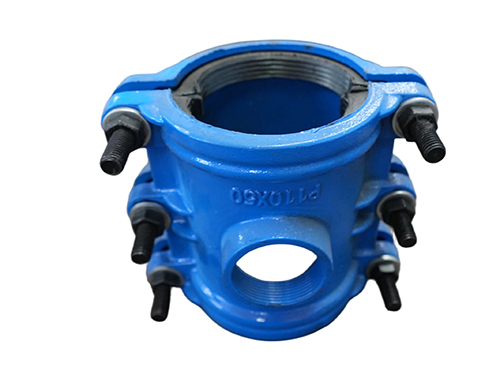
The clamp body is cast as two mirror-image halves. Depending on the factory, the molds are formed in green sand or resin-bonded sand around pattern plates. Repair clamps are a forgiving shape to cast, with no thin internal passages, but a few details separate good castings from average ones. The gasket channel must form cleanly, because rubber seats against this machined surface later. The bolt lugs need sound metal, since they carry the entire clamping load. And the bore has to allow enough machining stock to clean up without cutting into thin wall sections. Pattern maintenance is the quiet discipline here; worn patterns produce castings that wobble in the machining fixture, and tolerance drift follows.
Cleaning, machining and the details that matter
After shakeout, the castings are fettled to remove runners and flash, then shot-blasted to expose surface defects for inspection. The next stage is machining on vertical and horizontal centers: the bore is turned to the diameter tolerance, gasket channels are milled, lug faces are spot-faced flat so the nuts bear evenly, and bolt holes are drilled. Machining in-house matters for a manufacturer because the fit between the channel and the gasket is controlled here, not at the drawing stage. A channel cut too deep lets the gasket float; too shallow and the rubber cannot compress enough to seal a rough pipe surface. Either way, the defect is invisible until the fitting is in the ground.
Gaskets, bolts and coating
While the machine shop runs, the rubber line molds the gaskets. EPDM compounds for water service and NBR for gas and hydrocarbons are pressed in heated molds, then checked for hardness and dimensional consistency. Fasteners arrive from vetted suppliers in galvanized or stainless options, and a well-run factory audits them rather than trusting the label. The final surface treatment follows: shot blasting, zinc-rich primer and a fusion-bonded epoxy top coat, applied to a specified film thickness. On a buried fitting, that coating system is the difference between a clamp that looks its age after five years and one that looks its age after twenty-five.
Testing before anything ships
Reputable manufacturers test rather than assume. Batch samples from each melt go through tensile and hardness checks against the specified ductile iron grade. Finished clamps are assembled on sample pipe and hydrostatically pressured above the rated figure, with inspectors watching the gasket line for weep. Dimensional checks confirm that the width, bolt spacing and bore match the drawing, especially for custom OEM versions. The paperwork generated here, material reports and test certificates, is what allows a supplier to stand behind the fitting when a municipal engineer asks awkward questions three years after delivery.
Where custom work fits in
Standard catalogs cover the common cases, but a working factory gets constant requests for variations: wider bodies for long cracks, special gasket profiles for oval pipe, alternative drilling for overseas flange standards, or private labeling for distributors. Because the pattern shop sits a few steps from the melting line, a manufacturer can respond to these requests in weeks instead of outsourcing them into months. That responsiveness is the practical argument for buying from a factory rather than a catalog assembler, and it is why integrated plants keep winning utility and distributor business even when their unit price is not the lowest on the spreadsheet.
What the process teaches buyers
Understanding the production route turns vague quality talk into concrete questions. Ask about nodularity control, ask which machining is done in-house, ask to see a hydrostatic test record. The answers tell you whether you are dealing with a manufacturer or a reseller, and whether the fitting you bury will still be holding when the pavement above it has been repaved twice.
References
ASTM International, ASTM A536: Standard Specification for Ductile Iron Castings, West Conshohocken, Pennsylvania.
European Committee for Standardization, EN 1561: Founding, Grey cast irons, Brussels, Belgium.
European Committee for Standardization, EN 1563: Founding, Spheroidal graphite cast irons, Brussels, Belgium.
International Organization for Standardization, ISO 2531: Ductile iron pipes, fittings, accessories and their joints for water pipeline applications, Geneva, Switzerland.