

BLOGS
How to Choose a Pipe Repair Clamp Supplier You Can Trust
2026-10-21 05:51:58
How to Choose a Pipe Repair Clamp Supplier You Can Trust
Every pipe repair clamp looks the same in a product photo. Two gray castings, a black gasket, a handful of bolts. Yet the price gap between the cheapest and the best can be two to one, and the performance gap is wider. When the fitting is going underground on a live water main, that difference decides whether it holds for twenty years or weeps at the first frost. This article walks through how experienced buyers screen a supplier before the first order, based on what happens inside a casting factory.
Ask where the castings come from
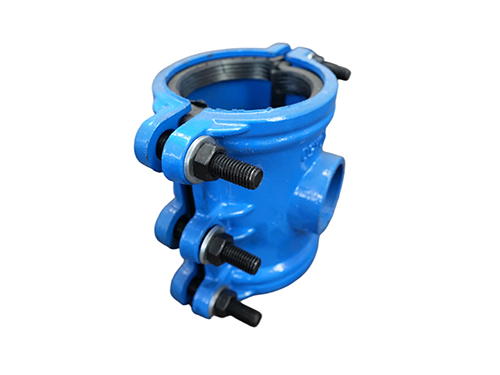
The first question is the simplest one. Does the supplier cast its own parts, or does it buy castings from a trading chain? A manufacturer that melts, molds and machines in one place controls the variables that decide quality: melt chemistry, nodularity of the iron, molding sand condition and machining tolerance. A factory that integrates casting with mold making can also respond to custom drawings, which matters if your project needs non-standard widths or flange drillings. None of this shows in a catalog, so ask directly and request workshop photos if a visit is not practical. Most genuine manufacturers are happy to show a melting line. Middlemen change the subject.
Read the material certificate, not the brochure
Good suppliers issue real paperwork with each batch. For ductile iron, that means a report showing tensile strength, elongation and hardness, checked against a recognized grade such as EN-GJS-400-15 or ASTM 65-45-12. For the gasket, it means a compound specification stating the elastomer type and its hardness in Shore A. For coated parts, it means the coating system name and applied thickness in microns. If the quote lists none of these and the seller describes everything as "standard quality", that phrase is doing a lot of unpaid work. Certificates cost almost nothing to produce when the product genuinely meets the grade, so their absence is a signal, not an oversight.
Pressure test data separates makers from assemblers
A repair clamp is a pressure vessel in the shape of a band. The only honest way to prove it is a hydrostatic test, with the fitting mounted on pipe and taken above its rated pressure while someone watches for weeping at the gasket and deformation at the bolt lugs. Factories that test routinely can hand you a report; factories that test only when a customer complains cannot. Ask also whether the test covers the full size range or just the popular diameters. Some manufacturers validate DN100 carefully and extrapolate everything above it, which is backwards, since large clamps see the highest bolt loads.
Compare gaskets with the service in mind
The casting rarely fails first. The rubber does. A supplier worth keeping stocks at least two compounds: EPDM for water and wastewater, NBR for gas, fuel and oil-bearing lines. Within one elastomer family, hardness around 60 to 70 Shore A suits most pipe sealing work, and the molding quality decides whether the gasket seats evenly around the full circumference. Check the cross-section for porosity and flash lines. A pitted gasket will pass a bench test and leak in the ground after the second season of ground movement.
Look at hardware and coating details
Bolts are the part everyone forgets until one seizes in a wet trench. Ask whether the standard offering is galvanized or stainless, and whether anti-seize is packed with each fitting. On the outside, a zinc-rich primer under a fusion-bonded epoxy layer is the proven system for buried service in aggressive soil, and any factory serving municipal water utilities will be familiar with the coating thickness requirements. Small details like chamfered gasket channels and machined lug faces tell you the tooling was maintained rather than run into the ground.
Weigh price against what a failure costs
The economics are not subtle. A repair clamp might represent two percent of the cost of a dig. The labor, the backhoe, the traffic control and the water lost through the leak dwarf the fitting price. Saving a few dollars per unit to buy from an unverified source therefore protects the smallest number on the invoice while exposing the largest. Utility buyers learned this the hard way during the low-bid years, and most now require traceable documentation precisely because a twenty-dollar gasket once cost a full re-dig.
Test the supplier with a small order
Before committing a season of purchases, run a trial. Order a small batch in two or three diameters, inspect the machining, and bolt a sample onto scrap pipe in the yard. Note how the supplier handles the inevitable questions: drawing revisions, packaging, marking, lead time updates. The response pattern during a small order predicts the service during an emergency order far better than any sales presentation. When a mains burst at two in the morning, the supplier you want on the phone is the one who already answered these questions calmly in daylight.
References
International Organization for Standardization, ISO 2531: Ductile iron pipes, fittings, accessories and their joints for water pipeline applications, Geneva, Switzerland.
ASTM International, ASTM A536: Standard Specification for Ductile Iron Castings, West Conshohocken, Pennsylvania.
American Water Works Association, Manual of Water Supply Practices M41: Ductile-Iron Pipe and Fittings, Denver, Colorado.
International Organization for Standardization, ISO 4633: Rubber seals, joint rings for water supply, drainage and sewerage pipelines, Geneva, Switzerland.