

BLOGS
Pipe Repair Sleeve vs Pipe Repair Clamp: Which One to Order
2026-10-29 10:54:19
Pipe Repair Sleeve vs Pipe Repair Clamp: Which One to Order
Suppliers get this question daily, and the confusion is fair. The two products photograph almost identically: metal halves, rubber, bolts. In the trench, they do different jobs, and ordering the wrong one turns a one-hour repair into a return visit. The short version is that a repair clamp seals a point fault, while a repair sleeve encircles and reinforces a length of damaged pipe. The details below are what that difference means in practice.
What a repair clamp is built for
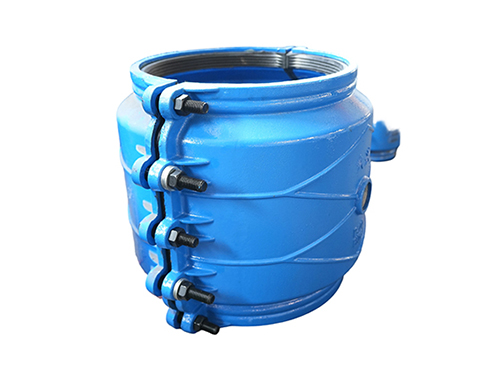
A standard repair clamp is a relatively narrow fitting, wide enough to bridge a pinhole, a weeping joint or a circumferential crack. Its ductile iron halves close over a molded gasket, and the seal comes from bolt compression flattening the rubber against the pipe. Because the body is short, it is light, cheap and fast to install, one crew member can carry a mid-range size down a ladder without help. The clamp does not add meaningful structural strength; it holds rubber in place. That is a fine arrangement when the pipe wall around the fault is still sound and the damage is local.
What a repair sleeve adds
A pipe repair sleeve is the long version. It runs from several hundred millimeters to over a meter along the barrel of the pipe, with gaskets seated near each end on sound metal. The extra length lets it seal across a longitudinal split, the fault type a narrow clamp simply cannot cover, because the split would run out past the gasket footprint. The sleeve also adds a measure of reinforcement: the full-encirclement body carries some of the hoop load and bridges over areas where the parent pipe has lost wall thickness. Manufacturers offer wide-body and multi-gasket configurations for serious barrel damage, and some utilities keep a couple of long sleeves in stock purely for this reason.
Match the fitting to the failure
The decision tree is short. A pinhole or a joint leak on otherwise healthy pipe: standard repair clamp. A circumferential crack from settlement or frost: repair clamp, possibly the wide-body type. A longitudinal split: repair sleeve, full stop, with the gaskets landing beyond both ends of the crack. General wall loss along a pipe length: neither product is a real cure, and the honest move is planning a replacement, though a sleeve can buy time on a schedule rather than an emergency. When in doubt, clean the pipe and measure the crack before calling the supplier; ordering from a description over the phone is how the wrong fitting arrives.
How the seals differ in practice
Both products seal by gasket compression, but the geometry changes the installation. A clamp has one sealing zone in the middle, so the crew concentrates on centering the gasket over the fault. A sleeve has two or more sealing zones, one at each end, and the pipe surface under both must be cleaned and sound. A sleeve installed with one end over corroded pitting will weep from that end no matter how carefully the bolts are torqued. This is why sleeve installations demand a longer prepared area, and why the digging is a bit more extensive. Budget the extra half hour.
Cost, weight and stock strategy
Per unit, sleeves cost more; they contain more iron, more rubber and more bolts. But comparing prices this way misses the point, because the two fittings are not substitutes. The real cost comparison is against the alternative repair for the same fault: a sleeve against a cut-and-replace spool piece, where the sleeve usually wins by a wide margin on a live main. For stock, most maintenance teams carry clamps in every site diameter plus a small number of sleeves in the sizes most prone to splitting, often the older cast iron runs. A supplier with both product lines in one catalog simplifies that stocking, since documentation and gasket compounds stay consistent across the range.
Two questions worth asking your supplier
First, ask whether their clamp range includes wide-body versions, since the middle ground between a standard clamp and a full sleeve covers many real-world faults. Second, ask about gasket continuity on the longer sleeves, because continuous rubber with intermediate compression lines handles barrel damage better than separate short gaskets that can each become a leak path. The answers tell you whether the manufacturer designs for pipeline reality or merely casts to a catalog drawing, a distinction that shows up years later in the ground.
A closing note on hybrid jobs
Field crews sometimes combine fittings, a clamp over a small fault now, with a sleeve planned over the weakened run the following season. That sequencing is legitimate engineering, not corner-cutting, provided the paperwork tracks it. The worst outcome is the unrecorded repair, whichever fitting was used, because the next crew inherits a mystery instead of a maintenance history.
References
American Water Works Association, Manual of Water Supply Practices M41: Ductile-Iron Pipe and Fittings, Denver, Colorado.
International Organization for Standardization, ISO 2531: Ductile iron pipes, fittings, accessories and their joints for water pipeline applications, Geneva, Switzerland.
European Committee for Standardization, EN 545: Ductile iron pipes, fittings, accessories and joints for water pipelines, requirements and test methods, Brussels, Belgium.
ASTM International, ASTM A536: Standard Specification for Ductile Iron Castings, West Conshohocken, Pennsylvania.