

BLOGS
Tapping Saddle Clamps: Branch Connections Without Shutting Down
2026-10-31 04:10:03
Tapping Saddle Clamps: Branch Connections Without Shutting Down
Every new service line, hydrant spur or subdivision feed starts the same way: someone has to put a hole in a main that everyone else is still using. The tapping saddle clamp is the fitting that makes this routine. It clamps onto the parent pipe, carries a valve or drilling machine on its outlet, and leaves behind a sealed branch. This article covers how saddles work and the details that separate a good installation from a wet one.
What the fitting actually does
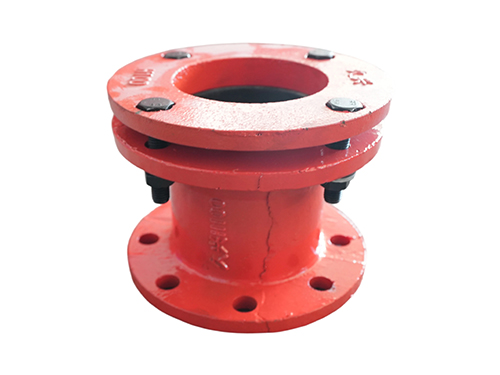
A tapping saddle is a curved ductile iron band that wraps part of the pipe barrel and terminates in a raised outlet, usually threaded or flanged. Under the band sits a gasket that seals around the intended hole location. The outlet gives the drill something rigid and centered to work through, so a proper saddle produces a clean hole instead of a ragged puncture. Once the hole is cut and the valve closed, the assembly becomes a permanent branch fitting. Two-, four- and six-bolt patterns exist, and the bolt count matters mainly on larger outlets, where the branch pipe's pull tries to peel the saddle off the barrel.
Saddle or tee: the choice behind the choice
The alternative to a saddle is cutting in a tee, which means shutting down, draining and excavating a longer section. On a transmission main serving a hospital district, that option is a negotiation, not a procedure. Saddles exist precisely for these situations. They are also the economical choice for small service branches: a DN50 outlet on a DN300 main needs a saddle and a drilling machine, not a full pipeline shutdown. The trade-off is honest: a saddle depends on the parent pipe's soundness, and a heavily corroded barrel may need a full encirclement version to spread the load.
Installing one properly
Installation follows the same discipline as any gasketed fitting, with two additions. First, the saddle must sit square to the pipe axis; an angled saddle drills an angled hole, and the branch inherits the error forever. Torque the band bolts evenly in stages, just as with a repair clamp, until the gasket compresses uniformly around the outlet boss. Second, before drilling, pressure test the assembly at the machine's test connection to confirm the gasket holds with the outlet pressurized. Drilling through a saddle that was going to leak is a mistake discovered at the worst possible moment, with a drill stem in the hole and water coming out around it.
Under-pressure tapping, in outline
The drilling machine mounts on the saddle outlet through its valve. With the valve open, the drill advances through the pipe wall under full line pressure, the coupon rides up the hollow drill, and the valve is closed before the machine comes off. Done correctly, no water escapes at any point. The technique rewards preparation: sharp cutters sized to the outlet, correct rotation speed, and a machine in working order. Most suppliers also specify compatible machines, and a factory familiar with the drilling side will dimension the outlet and gasket geometry to suit, worth more than it sounds when the crew is standing over a live main.
Materials and coating choices
Ductile iron is the standard body material, machined on the seating face to bear evenly on the pipe. The gasket under the band is typically EPDM for potable water, with NBR available for gas and hydrocarbon service. Because the saddle stays buried for decades with a branch hanging off it, corrosion protection is not decorative: zinc-rich primer under fusion-bonded epoxy is the usual factory system, and some buyers upgrade the fasteners to stainless for aggressive soils. Outlets come threaded to ISO 228 or flanged to EN 1092-1 drilling, so specify the standard when ordering; mismatched flange drilling is a discovered-on-site problem.
What to ask a manufacturer before ordering
Three questions cover most of the risk. Ask for the pressure rating of the assembly including the outlet, not just the band, because the boss is a casting with its own stress path. Ask whether the gasket is a one-piece double-seal type, which seals both around the pipe and around the drilled hole, a meaningful upgrade over single-seal designs. And ask for the outlet drilling standard and a dimensional drawing for your project records. A manufacturer who answers these from stock documentation is running a controlled process; one who answers with reassurance instead of paper is guessing, and you will be the one standing over the main.
Where saddles quietly fail
Saddles rarely fail dramatically. They seep. The usual culprits are torque applied unevenly, a seat installed over corrosion pits, and electrolytic attack at the branch connection where dissimilar metals meet a wet soil. A small leak found at a routine survey is fixable by re-torqueing if the gasket is intact; ignored, it washes out the bedding and the branch sags.
References
International Organization for Standardization, ISO 2531: Ductile iron pipes, fittings, accessories and their joints for water pipeline applications, Geneva, Switzerland.
European Committee for Standardization, EN 1092-1: Flanges and their joints, circular flanges for pipes, valves, fittings and accessories, PN designated, Brussels, Belgium.
American Water Works Association, Manual of Water Supply Practices M41: Ductile-Iron Pipe and Fittings, Denver, Colorado.
International Organization for Standardization, ISO 4633: Rubber seals, joint rings for water supply, drainage and sewerage pipelines, Geneva, Switzerland.